Lead Verification Software and Lead Validation Services for TCPA Consent
Lead verification software checks each lead before your team contacts it: is there a consent record, does the phone number match the one the consumer typed, is your brand named in the disclosure, and is the number clear of Do Not Call lists. ConsentVerified runs those checks through an API or a batch upload, returns pass, hold or fail with the reason, and keeps the evidence. Paste a vendor's form disclosure below to see how it scores.
Check your disclosure up to 5 times per day. The score, checklist, suggested rewrite, and certificate preview need no signup.
Your full disclosure report
Every check, a suggested rewrite of your disclosure, and a certificate preview with a real SHA-256 hash of the text you submitted.
Disclosure checklist
- Pass
- Needs attention
- Not applicable to this channel
A text check does not inspect the rendered form or establish its font size, placement, link behavior, or visibility. Confirm those elements on the live page and preserve the session evidence.
Suggested rewrite
Review this wording against your actual sellers, contact methods, form design, and messaging program before publishing it. A rewrite helps address flagged elements and does not guarantee compliance.
Certificate preview
- Certificate ID
- SHA-256 hash
- Timestamp
- Channel
- Sellers
- IP address
- User agent
This certificate preview shows a real SHA-256 hash of your submitted disclosure and the details of this check session. It records your disclosure check, not a consumer's opt-in to a lead form.
The checker reviews language only. It does not establish legal compliance or replace a review of the complete consent experience. The score reflects disclosure checks, not a legal determination. A Defensible status does not establish that a person gives valid consent or that a particular call or text is lawful.
Keep the evidence with the lead
Create your account to connect your forms, capture consumer consent sessions, and use the evidence tools included in your plan.
Why lead buyers verify every lead, not a sample
A lead that arrives with a "TCPA compliant" flag is a promise from the vendor, not proof. The proof is the consent record behind it, and buyers usually find out it is missing only after a demand letter asks for it. By then the call or text has been made, and the TCPA allows $500 per call or text, up to $1,500 when a court finds the violation willful.
Spot checks do not hold up well against that math. If one source sends 8,000 leads a month and 3 percent have no usable consent, sampling 100 leads will often show nothing wrong while 240 bad numbers reach the dialer. Verifying every record at intake costs a fraction of a cent per lead on a flat plan and removes the guesswork about which sources are clean.
Verification also pays off outside of litigation. Leads that fail on phone mismatch or stale consent are the same leads that do not answer, so filtering them improves contact rates and gives you a documented reason to request returns or credits from the vendor.

What the Lead Verification API checks on each lead
Send the lead with its certificate reference when it arrives, from your lead distribution platform, CRM or a webhook. The API answers in the same request, so your routing rules can act before anyone dials.
- Certificate present and captured at the time the form was submitted, not attached later.
- Phone number on the lead matches the phone recorded with the consent action.
- Your brand, or the seller you call for, appears in the disclosure the consumer saw.
- Consent age is inside the window your policy accepts, for example 30 or 90 days.
- Disclosure wording scored on 15 elements, including seller identification, automated technology language and the statement that consent is not a condition of purchase.
- Number screened against the National Do Not Call Registry, state lists and your internal suppression list.
Every result carries the reason code, so a failed lead shows exactly what broke, and a held lead lands in a review queue with the evidence open for a compliance analyst.
Lead verification vs lead validation services
The two terms get used interchangeably, but they answer different questions, and most buyers need both.
| Check | Lead validation | Lead verification for consent |
|---|---|---|
| Question it answers | Is this contact data real and reachable? | Can I prove this person agreed to hear from me? |
| Typical checks | Email syntax and mailbox, phone line type, address format, duplicates, bot signals | Consent certificate, phone match, named seller, consent age, disclosure score, DNC status |
| What a failure costs | Wasted dials and bounced email | Statutory damages per call or text |
| Who owns it | Marketing operations | Compliance and lead buying |
| Where ConsentVerified fits | Phone match check only | Full coverage, with evidence kept for 1 to 7 years |
If you already pay for email or phone validation, keep it. ConsentVerified adds the consent layer those tools do not see, and it does not replace a fraud or identity data vendor.
Who buys lead verification software
- Lead buyers in insurance, Medicare, final expense, solar, home services and mortgage who purchase from several vendors and need one acceptance standard across all of them.
- Outbound call centers that dial purchased leads and want failed records blocked before they reach an agent. See the call center compliance software page for the pre-dial flow.
- Lead generators and publishers who sell leads and want to show buyers a verified certificate on every record, which often supports a higher price per lead.
- SMS marketers who must prove opt-in for every number before a campaign goes out, alongside SMS consent records.
- TCPA defense counsel and compliance consultants who audit a client's lead sources and need exports they can read.
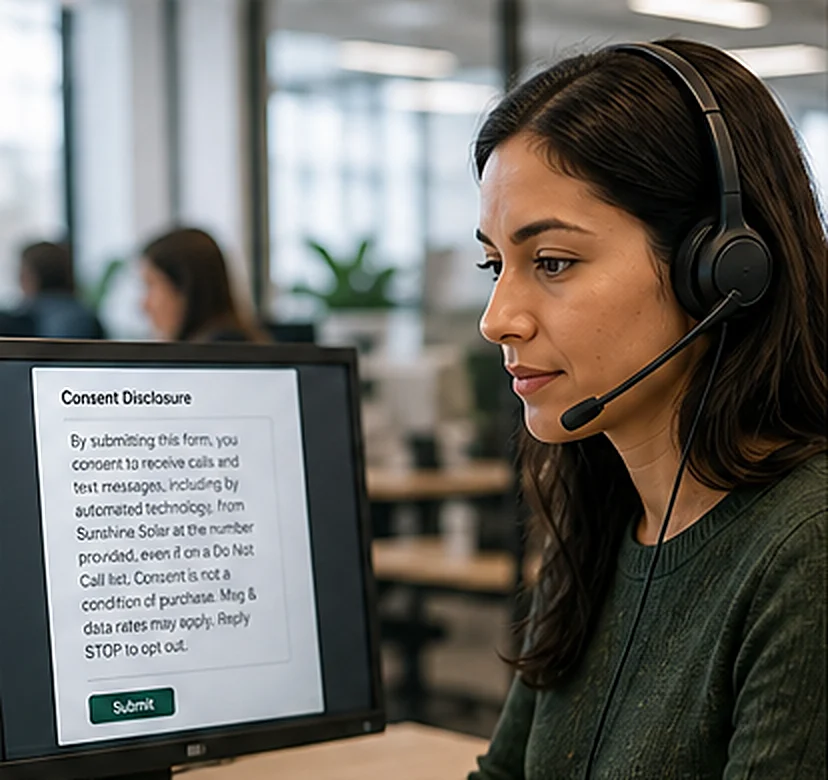
How to verify leads before you call
1. Add the capture snippet to your own forms, or require each vendor to attach a certificate reference to every delivered lead.
2. Set your acceptance rules: maximum consent age, required seller name, minimum disclosure score and DNC sources.
3. Connect the Lead Verification API to your intake, or upload a CSV batch before a campaign starts.
4. Route results automatically: pass goes to the dialer or CRM, hold goes to review, fail goes back to the vendor with the reason.
5. Export the evidence package, PDF for counsel and JSON for your systems, whenever a complaint names a number.
The full flow, including the certificate format, is on how it works.
How ConsentVerified compares for lead verification
| Factor | ConsentVerified | TrustedForm Verify | Jornaya TCPA Guardian |
|---|---|---|---|
| Pricing | Flat monthly plans from $149, published | Per lead, $0.15 falling to $0.08, published | Quote based annual contract |
| What it verifies | Certificate, phone match, seller name, consent age, disclosure score, DNC | TrustedForm certificate contents | Jornaya lead ID session and disclosure |
| DNC scrubbing included | Yes, federal, state and internal | No, separate vendor | No, separate vendor |
| Evidence retention | 1 to 7 years by plan | Retain product billed separately | Set in your contract |
| Works with any vendor | Yes, with the capture snippet or a certificate reference | Vendor must run TrustedForm | Vendor must run the LeadiD script |
TrustedForm and Jornaya have far larger publisher networks, which matters if your vendors already run their scripts and refuse anything else. Compare the details on the TrustedForm alternative and Jornaya alternative pages.
Lead verification questions
How do you verify a lead?
You verify a lead by checking three things before contact: the contact data is real, the consent record exists and names your brand, and the number is not on a Do Not Call list. Lead verification software does this automatically at intake and stores the result, so you can show later what you checked and when.
How much does lead verification cost?
Pricing usually runs per lead or per month. TrustedForm Verify publishes per lead rates from $0.15 down to $0.08, and Jornaya quotes annual contracts. ConsentVerified uses flat plans: Starter at $149 per month includes 1,000 verifications, and Growth at $499 per month includes 25,000 verifications plus 50,000 DNC scrubs.
What is the difference between lead validation and lead verification?
Lead validation checks that contact data is real and reachable, such as a working phone line or a deliverable email. Lead verification, in the TCPA sense, checks that the consumer gave consent to be contacted by your brand and that you can prove it. Validation saves wasted dials, verification prevents lawsuits.
Can I return leads that fail verification?
Usually, yes, if your insertion order with the vendor says so. Write the acceptance rules into the contract, such as a certificate on every lead, a phone match and your brand named in the disclosure, then use the fail reason from each check as the documented basis for the return or credit.
Do I still need lead verification if my vendor says leads are TCPA compliant?
Yes. A vendor's assurance does not shift liability to the vendor, and buyers who call without valid consent can be sued directly. Verifying each lead creates your own record that consent existed when you received the lead, which is what counsel will ask for.
Does ConsentVerified work with my lead distribution platform?
It connects through the Lead Verification API, API keys and webhooks, which are included on every plan. Any platform that can post a lead to an endpoint and read the response, including most lead distribution systems and CRMs, can call it at intake and route on the result.
Growth fits most lead buyers
Growth costs $499 per month, or $249 per month billed yearly, and includes 25,000 lead verifications, 50,000 DNC scrubs, 50,000 consent certificates, unlimited consent language audits, 10 seats with roles and 3 years of evidence retention. Buyers verifying more than 25,000 leads a month or keeping evidence for the full four year TCPA limitation period move to Scale at $1,299 per month, with 150,000 verifications and 5 years of retention.
Verify every purchased lead before you contact it
Connect your vendors, set your acceptance rules and keep the evidence that answers a demand letter. For pricing math against per lead certificates, read TrustedForm pricing, or check the consent language checker on your vendors' forms first.